+++JORGARD+++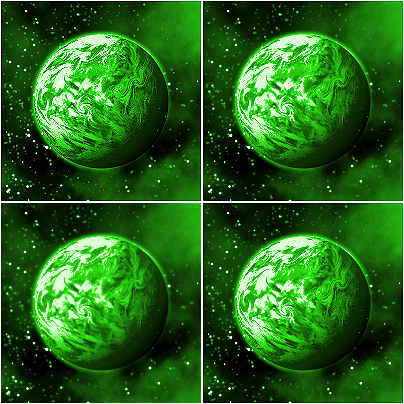 Planet name: Jorgard (Cerea I) World class: Agriworld Population: ~70,000,000 Tech level: Early stellar (GTL of early TL9) Tithe Grade: Exactis Extremis Aestimare: ? Orbital distance: 0.16 AU Equatorial diameter: 8,755 km Gravity: 0.69 G Orbital period: 46.72 Terran days Length of day: 93.44 Terran days Atmosphere: Standard nitrogen-oxygen mix Surface atmospheric pressure: Thin (0.69 atm) Surface temperature: -6° C Hydrosphere: 47% Life forms: Early metazoan (simple indigenoius ocean life); plants and animals (introduced) Moons: None Planet description: Jorgard is usually considered to be a primitive agriworld ruled by a stagnant feudal aristocracy. The climate is highly variable, as the planet rotates its sun (Cerea) in a resonant pattern, with one day lasting roughly 93 Terran days. A long summer-day period is followed by a long frozen-night period. During the day, crops are planted and then grown at a high-rate due to a combination of constant sunshine, low-gravity, and thin-atmosphere. During the night a period of semi-hibernation ensues. The planet is covered by one large continent divided-up by a multitude of lakes/oceans of varying size. The upper latitudes are largely dominated by very-thick glaciers, while the equatorial regions contain grasslands, deserts, and some taiga-forests. The noble-classes are the legal rulers of Jorgard. Coming from a long-line of warrior-templars, they are the descendants of the few Heros of the Imperium which survived the Sargassos Chaos Rebellions during the Age of Imperium. Their expertise of modern agriculture is very limited however, and has been supplemented by knowledgable off-world immigrants. This second-class nobility (or bourgeoisie) has been given allodial rights to land, as well as serfs and slaves to cultivate them. Today, Jorgard is a world in change, as a power struggle exists between the Nobility of the Sword and the Agricultural Bourgeoisie. To an “off-worlder” however, the aristocracy is in firm control of the planet, maintaining a very rigorous “Caste” social system. Significant locations: The cultivable and resource-rich territories of Jorgard are divided up into ten Earldoms. These represent major land-divisions, each controled by a sovereign Earl and his dinasty. Each Earldom is further sub-divided into Manorial Domains which form the basis for Jorgard's agricultural operations. A couple populated urban-area also exist and are typically regarded as "free city-states" where off-world commerce is conducted; the cities are also under different laws than the agricultural lands, and the rigid caste-system starts to disintegrate. Entrance into these city-states is highly regulated and serfs/slaves are typically not allowed-in. Government: The power-structure on Jorgard is an ancient and regimented form of feudalism. Each of the ten Earldoms is ruled by an Earl and his dynasty (or Earlprinz in case of a Grand-Earldom). This small group of ten high-nobles forms the Adelkonzil, a sort-of elite council which chooses/elects the Earlkonige (Imperial Commander) from one of them. Of course, each Earl's Court has a great deal of influence in their political decision-making. An Earlkonige is selected for life, or until he is deamed "unfit" to rule. The selection process is anything but a peacefull afair however, as each Earl must prove his worth. This is usually achieved with highly ritualized duels; the death or injury of an Earl during such occasions is rare, but does happen on occasion. Duels are not the only means of selection however; sometimes ritualized battles take place, during which large numbers of the lower classes may be made to fight to help determine the new Earlkonige. Such battles are refered to as an Konigeleikr (or King's Game), which has a popular boardgame equivalent of the same name. Even though the "Bourgeoisie" doesn't hold any official political power, their opinions do cary some weight with the aristrocracy. After all, the Odalsmenn hold Odalstitel rights (allodial rights) to their lands and have a great deal of influence on the inter-subsector economy. Therefore, the nobility must keep the middle-classes happy if they want to meet their tithe quotas. Of course, this sort of intimidation goes both ways, and the aristocracy is quick to show-off it's military strength if they start to feel threatened. Religion: The aristocracy of Jorgard harbours an early and radical form of the Cult Imperialis. The noble-classes are descendents of pilgrims who turned into warrior-templars to protect the newly ascended God-Emperor, as well as their own freedom to worship Him. A lot of ancient shrine-cathedrals can be found spread-out across Jorgard, but especially on the Heligkaizer Mountains which are said to resemble the Emperor’s face from space. With the exceptions of a few fanatics, most aristocrats let the lower classes worship the Emperor in any way they choose (as long as they worship Him); they realize that with the high degree of variety in the world’s population, a uniform religious outlook would be impossible. Religious views vary widely among the middle & slave-classes, depending mainly on their worlds of origin. Some of the bourgeoisie has strived to practice the “noblemen’s cult” in hope of preferential treatment, while other have done the exact opposite in a sign of defiance. Society and law: There are three distinct groups on Jorgard: the ruling class, the bourgeoisie, and the unfree. Each group has a specific role to play in the economy of this planet: the nobility rules, the bourgeoisie supervises, and the slaves do the hard work. This power structure is, according to the nobility, rigid and unbreakable. But the bourgeoisie has since its inception tried to rival the aristocracy for political strength, and although no official power resides outside of the ruling-classes, various compromises have been reached over the past millennia. The laws of the land also vary by Earldom and between classes as well: the nobles enjoy a privileged status, but expect for a few sovereign individuals, are still bound by law. The bourgeoisie can usually act freely as long as their farms are productive. The lower-classes are either second-class citizens with few rights, or are basically slaves and are treated as property. The Ruling-Class: Officially known as the Svertadel or Nobility of the Sword, this class encompasses all those who can trace their inheritance back to the original warrior-templars of Jorgard. This descendance has to be pure and unadulterated to be valid. Therefore, marriages for the ruling-classes are complicated and carefully planned. Both sides have to prove their lineage back to the beginning; consequently, all members of the nobility are essentially cousins, albeight in various degrees. At the top of the aristocratic chain-of-command lies the Earlkonige, the “elect/chosen” Imperial Commander. Under him is the Adelkonzil (Noble’s Council), which is composed of his fellow Earls and Earlprinz’. An Earlprinz or Earl is at the head of a dynasty, which rules over an Earldom. Members of his dynasty or court are known as Barons and form the vast majority of the nobility. Barons are the second born sons and daughters of Earls or, more frequently, the offspring of other Barons. The occupations of Barons is very varied: some are given hereditary titles to Manorial Domains while others become advisors, spies, mercenaries, or templars. Some may even seek to increase their wealth by marrying into the bourgeoisie, and therefore forfeiting their noble status. One of the more popular career options for Barons is to become a templar in the Tivaritter orden. These templars maintain the ancient traditions of the “old-guard” nobility, and keep a close watch on any heretical activities. Acceptance into the order is only possible before the age of 6 however. The Bourgeoisie: This group is commonly referred to as the Tainus and represents the agricultural-bourgeoisie of Jorgard. Members of the Tainus consider themselves quite respectable as their heritage is only second to that of the nobility. Typically each manor in an Earldom is controlled by a family of the bourgeoisie; these families hold hereditary rights to these lands which cannot be taken-away by law, except under extreme circumstances (such as heresy or Chaos-worship). At the head of these families are the Odalsmenn, usually the oldest son. These individuals can hold a good deal of influence, especially when a group of families stand togheter. They have the right to initiate interstellar trade with their surplus agriproducts, and some have become quite weathly as a result. The vast majority in the Tainus class are the Freimenn, men and women without hereditary titles who are free to undertake a variety of jobs. Some stay on the manor and help maintain the farmlands, while others move to the free-cities and engage themselves in other occupations. A good portion of the Tainus class also belongs to the Guildemenn and devote their whole lives (usually since childhood) to a peticular craft. The most powerful Guilde is the one that maintains and repairs the agricultural equipment of the Odalsmenn. Guilde list (a small selection): Belunguilde (artillery/armour corps); Bœrguilde (farming equipment); Erkundguilde (scout/sniper corps); Fiskguilde (fishing equipment); Jagerguilde (hunting); Kaupguilde (trade agricultural); Ondguilde (funeral services); Skuldguilde (heraldry & lineage); Smidaguilde (building construction); Trellguilde (trade slave); Vindguilde (air/spacecraft maintenance)… The Unfree: The largest portion of the population on Jorgard are the Sklaven. This class is composed of serfs (Servus) and slaves (Trells). The Servus are essentially indentured servants with limited personal rights; most perform the semi-technical work on a manor's farm, while a small portion is allowed into the free-cities to assist the Freimenn or Guildemenn. Finally come the Trells, which are true slaves with no personal rights at all. Not all Trells are "made" the same though; some are lobotomized servitors, and some are criminals condemned to a short-life of hard-work. The Trells have a pretty high turn-over rate, usually lasting one or two seasons at most. Technology: The availability of technology on Jorgard is, like everything else, governed by ones social status and occupation. In general the nobility has easy access to "early-stellar" technologies (equivalent to GTL of early TL9), therefore they can afford to live in great comfort; some of the more powerful Earls might even have a primitive sub-stellar ship in orbit. The nobility, however, can also get mainstream imperial technologies with relative ease. This is especially true for vehicles and military gear (GTL available are between late TL 9 to well into TL 10). The bourgeoisie and lower-classes will generally live at a pre-stellar level equivalent to that of an early-atomic society (GTL of later TL6). However, most Odalsmenn and Guildemenn have relatively easy access to standard Imperial agricultural equipment and vehicles (GTL of early TL10). Trade and tithes: Jorgard is one of the agriworlds in the Sargassos Subsector. It is closest to the miningworld Laguna (~3.26 light years) and to the hiveworld Theta Corionis (~4.6 light years), with which i conducts most of its trade, exporting agriprodukts & consumables in exchange for high-tech manufactured products (vehicles and parts). Even though this world's primary resource is agriprodukts, it also has an interesting array of other resources & manufactured products. One of the reasons why the soil of Jorgard is suitable for agriculture is the fair amount of ores, crystals, & chemical compounds that are found. These resources haven't been exploited in any significant way, but the bourgeoisie is starting to open-up new mines to supplement their agriprodukt incomes. Processed goods are dominated primarily by agriprodukts, with a small amount of metals being refined in the free-cities. Some of agriprodukts are used to create pharmaceuticals for export. There are also a couple weapons-factories spread thinly around the planet which mainly re-supply the local PDF and Imperial Guard regiments. Weapons produced are mainly simple fire-arms, but with some energy weapons too. Physiology: The low gravity/atmosphere and limited solar luminosity of Jorgard will, with time, have some physiological effects on its inhabitants. The nobility, for instance, tends to be tall and slender (although not freakishly so); a larger chest is also a characteristic of the nobility, because of the thin atmosphere. Younger generations of "Jorgardians" come is a wide variety, depending on their own worlds of origin. Likewise, the lack of sunlight has given the nobility a very characteristic pallour, although eye and hair colour is highly variable. Psychology: A strong disparity exists in the ideologies of the nobles and the bourgeoisie. The ruling-classes are very reluctant to change, and they know their status would be strongly challenged if the economic profile of Jorgard was altered. Therefore, the nobility wants to keep producing agriprodukts primarily, and is reluctant to diversify other potential manufacturing processes. The bourgeoisie, on the other hand, is more economically pro-active and are open to new ideas. More and more ore/crystal mines are popping-up on various manors. Therefore you will find much more "free-thinking" and creative problem-solving amongst the agricultural-classes. There is a similar difference of opinion when it comes to resolving conflicts. The nobility, due to its long martial tradition, is quick to use force; the bourgeoisie is more willing to use diplomacy and negotiations. The ideas & concerns of the lowest-classes (Slaves & Serfs) is generally kept in check by the noble/bourgeois block. Therefore, serfs and slaves are typically of a gloomy character, tittering on the verge of revolt. Language and dialect: All members of the noble-classes are thaught and can speak High Gothic fluently, however they usually only do so at official receptions or ceremonies (or when showing-off to the lower classes). Most of the time aristocrats will converse with an ancient Jorgardian Low Gothic dialect known as Fjellmál. Some common characteristic of Fjellmál include things like the lack of the letter "w" (a "v" is used instead); also "a" and "o" sounds tend to be pronounced in a long fashion. There is also a wide variety of Low Gothic dialects amongs the Freemenn and Serf classes (more so for the latter). The agricultural bourgeoisie has, since its early inception, created a common Low Gothic dialect especially suited for farming & commerce; this dialect is use when conversing within Freemenn circles, although each Odalsmenn clan is likely to also know some ancetral Low Gothic dialect from its ancient world-of-origin. PDF & Imperial Guard regiments: ... History: The Age of Imperium: this planet is colonized shortly after the Horus Heresy (around 044.M31) when Warpstorms weaken in the Sargassos subsector. Strong religious fervour is born on the world as lots of followers of the proto-“Cult Imperialis” gather there. Shrine-cathedrals are built in reverence of the God-Emperor. In M32 when the new Cult is officially recognized as the Empire's religion this world quickly becomes a destination for pilgrims in the Subsector. the Holy Order of the God-Emperor is created to serve as the elite of the planet’s PDF. This Order takes part in the various anti-Xenos wars in M32. The Age of Apostasy: In 360.M36, as the Sargassos subsector becomes the home of large number of rebellious chaos cults, this world remains firmly loyal to the Imperium (well at least the Imperial Cultists & Order-Templars). Small pockets of rebel chaos cultists do appear however and are quickly joined by off-world cultist armies (aided by the Alpha Legion). Despite the bravour of the Templars, most of the world's population is exterminated by the fallen Astartes and their cultist hordes. A few survivors manage to hold-out long enough in the mountains before being rescued by the Imperial forces. The Dark Millenium: The current feudal-like structure of society evolves over the following millennia. Surviving members of the Templars form the Noble Houses of the world. As new economic pressures for agriproducts arise in the subsector, new colonists come-in to toil the land, while Pilgrims come to see the Emperor's Mountain Range. Timeline: 044.M31: Colonization M32: Cult-Imperialis is officially recognized 360.M36: Sargassos Subsector Rebellion ... Glossary: Baron: Noble member of an Earl's dinasty or court. Earl: Ruler and holder of a hereditary title to an Earldom. Earldom: One of the ten Earldoms on Jorgard. Earlkonige: Earl who also holds the title of Imperial Commander. Earlprinz: Ruler and holder of a hereditary title to a Grand-Earldom. Freimenn: Member of the agricultural-bourgeoisie. Guildemenn: Freimenn member of one of the many Guilds. Manor: Basic division of land used for agriculture. Odalsmenn: Head of a Freimenn family and holder of a hereditary title to a Manor. Odalstitel: Allodial-title to a Manor, usually held by Odalsmenn. Servus: The serfs of Jorgard. Sklaven: The lowest social-class with serfs and slaves. Svertadel: The Ruling social-class known as the "Nobility of the Sword". Tainus: The agricultural-bourgeoisie. Trell: Slave-class, usually mindless servitors or condemned criminals. Customs: The nobility is very set in its ways, and puts special attention to old superstitions. Likewise, all nobles are required to attend a certain type of school-monastery (be it for stewards, templars, priests, etc...). Segregation between groups and even in-groups is common. Families tend to stick togheter and don't let much outside influence in. Wargaming in the Anargo Sector: ... Roleplaying in the Anargo Sector: ... |